RimbaScape Guide
Overwatering Indoor Plants: The 5W1H Guide to Healthier Roots
Learn who is most at risk, what overwatering really means, when to water and how to prevent root rot, yellow leaves and fungus gnats.
Takeaway 1
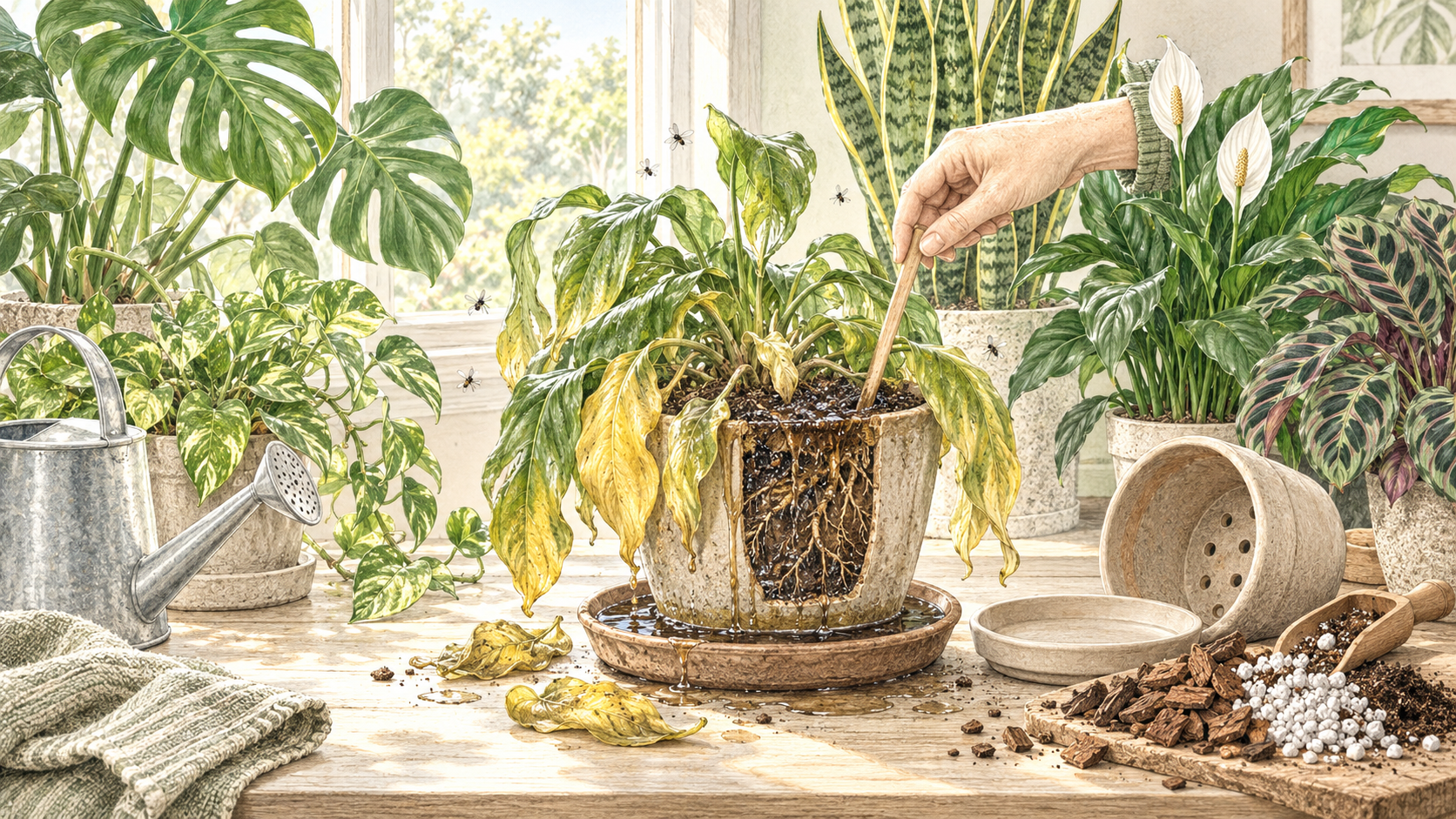
Drooping or yellow leaves do not always mean a plant needs more water; roots may be too wet to function well.
Takeaway 2
Water according to the growing media, light and plant type instead of a fixed calendar schedule.
Takeaway 3
Thorough watering, free drainage and appropriate drying between waterings protect healthy roots.
Why Indoor Plants Shouldn't Be Overwatered
Indoor plants often look simple to care for: place them near a window, add fertiliser and give them water. But watering is where many indoor plants quietly run into trouble.
When leaves begin to droop, the natural reaction is often, “Maybe this plant needs more water.” Unfortunately, drooping leaves do not always mean the plant is thirsty. A plant with too much water around its roots can show surprisingly similar symptoms.
Understanding the who, what, where, when, why and how of watering is more useful than following a fixed schedule.
Who: Which Indoor Plants Are Most at Risk?
Almost any indoor plant can suffer from overwatering, but some are more sensitive than others. Plants that generally prefer their growing media to dry partially between waterings include:
- Snake Plant (Dracaena trifasciata)
- ZZ Plant (Zamioculcas zamiifolia)
- Pothos (Epipremnum aureum)
- Philodendron, Monstera and Rubber Plant
- Succulents and cacti
These plants often store some moisture in their leaves, stems or roots and do not need constantly wet media. Calathea, Peace Lily, ferns and Fittonia may prefer more consistent moisture, but consistent moisture is not the same as permanently saturated soil. Even moisture-loving plants need oxygen around their roots.
Different plants need different moisture levels. There is no universal rule such as “water every three days”: plant type, growing media, pot size, light level and environment should determine the frequency.
What Exactly Is Overwatering?
Overwatering does not simply mean pouring a large amount into a pot once. The more important issue is how long the root zone remains saturated. You can water thoroughly and still be watering correctly if excess water drains quickly.
Overwatering normally happens when the media stays wet for too long because of frequent watering, poor drainage, compact media, pots without drainage holes, oversized pots, low light, poor airflow or water trapped inside decorative pots.
Think of the pot as a small underground environment. Roots need both water and oxygen. When most air spaces in the growing media remain filled with water for extended periods, oxygen availability falls and the plant begins struggling below the surface.
Where Does Overwatering Damage Begin?
The problem normally starts at the roots. Healthy roots require moisture and oxygen; saturated media limits oxygen movement around the root zone. Roots become stressed and eventually damaged, making them less efficient at absorbing water and nutrients.
The pot may contain plenty of water, but the plant can still look wilted because damaged roots cannot function properly. Overly wet conditions may also encourage organisms associated with root rot.
Signs to look for
- Yellowing, drooping or soft leaves; brown or dark patches; and premature leaf drop
- Softening or darkening stems, especially near the soil line
- Growing media that stays wet for many days, smells sour or develops surface mould
- Repeated fungus gnats around the plant
Yellow leaves alone do not prove overwatering. Nutrient deficiencies, insufficient light, pests and normal leaf ageing can also cause yellowing. Look at several symptoms together before reaching a conclusion.
When Should You Water Indoor Plants?
Do not water simply because today is watering day. Instead, water according to the condition of the growing media. For many common indoor foliage plants, checking the upper 2-5 cm of media is a useful starting point. If it still feels noticeably moist, watering can usually wait.
Three useful moisture checks
- Finger test: wet or cool means wait; dry may mean watering is appropriate depending on the plant.
- Lift the pot: a freshly watered pot is much heavier; it becomes lighter as water leaves the media.
- Wooden chopstick test: insert it deep into the pot for several minutes. Dark and moist means plenty of water remains; mostly dry and clean may mean it is time to water.
The chopstick test is especially useful for deep pots where the surface looks dry while the bottom remains wet.
Why Is Overwatering Harmful?
Roots need oxygen for respiration. Good growing media has pore space that allows oxygen to move through the root zone. When those spaces stay filled with water, the roots become stressed.
Prolonged wet conditions can also favour root diseases. Healthy roots are normally firm; damaged roots may be brown, black, soft, mushy or foul-smelling. Once significant root damage occurs, the plant struggles to support its leaves and new growth.
You may notice smaller new leaves, slower growth, fewer new shoots or no obvious growth for long periods. Adding more fertiliser does not solve this if roots are unhealthy; correct the root environment first. Persistently moist organic media can also favour fungus gnat larvae.
How Should Indoor Plants Be Watered Correctly?
The solution is not tiny amounts of water every day. Focus on thorough watering followed by appropriate drying.
Water thoroughly and drain excess
When watering is required, moisten the root zone properly. For pots with drainage holes, let excess water drain from the bottom, then discard water collected in the saucer or decorative pot.
Wet thoroughly, drain excess, allow appropriate drying, then water again only when required.
Use pots with drainage holes
Drainage holes let excess water escape instead of accumulating at the bottom. Decorative pots without holes can be used as cachepots: keep the plant in a separate nursery pot with drainage holes, remove it to water, let it drain and return it afterwards.
Improve the growing media
Indoor plants benefit from media that balances moisture retention, drainage and aeration. Depending on the plant, this may include coco peat, coco chips, perlite, pumice, orchid bark, compost, rice husk or a suitable commercial potting mix.
The goal is balance. Media that is too dense keeps roots wet; media that is too porous dries too quickly.
Match watering to light and pot size
Plants in stronger suitable light generally use water faster than the same plant in a dark corner. Low light slows photosynthesis, growth and water use, which is why indoor plants may need watering less frequently than outdoor plants.
A tiny plant in a huge pot can also cause problems: the unused volume of media may remain moist much longer than its small root system requires. Increase pot size gradually instead of moving a small root ball into an unnecessarily large container.
What If You Have Already Overwatered a Plant?
If the media is simply too wet but the plant otherwise appears healthy, stop watering temporarily. Move it to suitable light with reasonable airflow and good drainage, and let the media dry appropriately. Do not immediately add fertiliser.
If the plant keeps declining, inspect the roots. Severely damaged roots may need to be removed with clean tools before repotting into suitable fresh media.
A Simple Watering Checklist
- Who? What plant am I growing, and how much moisture does it prefer?
- What? Is the growing media actually dry enough to require water?
- Where? Is moisture trapped at the bottom of the pot or decorative container?
- When? Does the plant genuinely need watering today?
- Why? Am I watering because the plant needs it, or simply because it is my usual watering day?
- How? Can excess water drain freely after watering?
Final Takeaway
Most indoor plants do not decline because their owners do not care enough. Sometimes they receive too much care in the form of water. The best watering routine is not a rigid calendar; it is a process of observation.
Check the growing media, understand the plant, provide suitable drainage, consider light and airflow, then water only when the root zone requires it. Healthy roots create healthy plants — and sometimes the best thing you can do today is simply not water it yet.
Need Help With Indoor Plant Care?
Rimba Scape Solutions can assist with indoor plant selection, growing media, repotting, plant health assessment and ongoing indoor landscape maintenance. If your plants have yellowing leaves, root rot, slow growth, fungus gnats, repeated wilting or unsuitable growing media, an assessment can help identify the actual cause before replacing the plant.
Need help with this?
Send RimbaScape photos, location, sunlight condition and your budget range. We will advise whether you need plant supply, maintenance or a site visit.
Request an indoor plant health assessmentMore Guides
Organic vs Chemical Insecticides Around Pets
Learn how to control garden pests with a lower-risk, targeted approach for homes where cats, dogs and other pets spend time.
Read guideLawn Maintenance Guide: Mowing, Trimming & Clean-Up
Keep your lawn neat, healthy and safe with regular mowing, grass trimming, weed removal and garden clean-up.
Read guidePlant Health Treatment for Yellow Leaves, Pests & Weak Growth
Not all struggling plants need to be replaced. Some can recover with better watering, soil, pruning and pest treatment.
Read guide