RimbaScape Guide
Chemical Pesticide Label Colour Levels in Malaysia
Learn how Malaysia classifies chemical pesticide labels by toxicity level, colour band and warning statement, and why this matters in safe landscape maintenance.
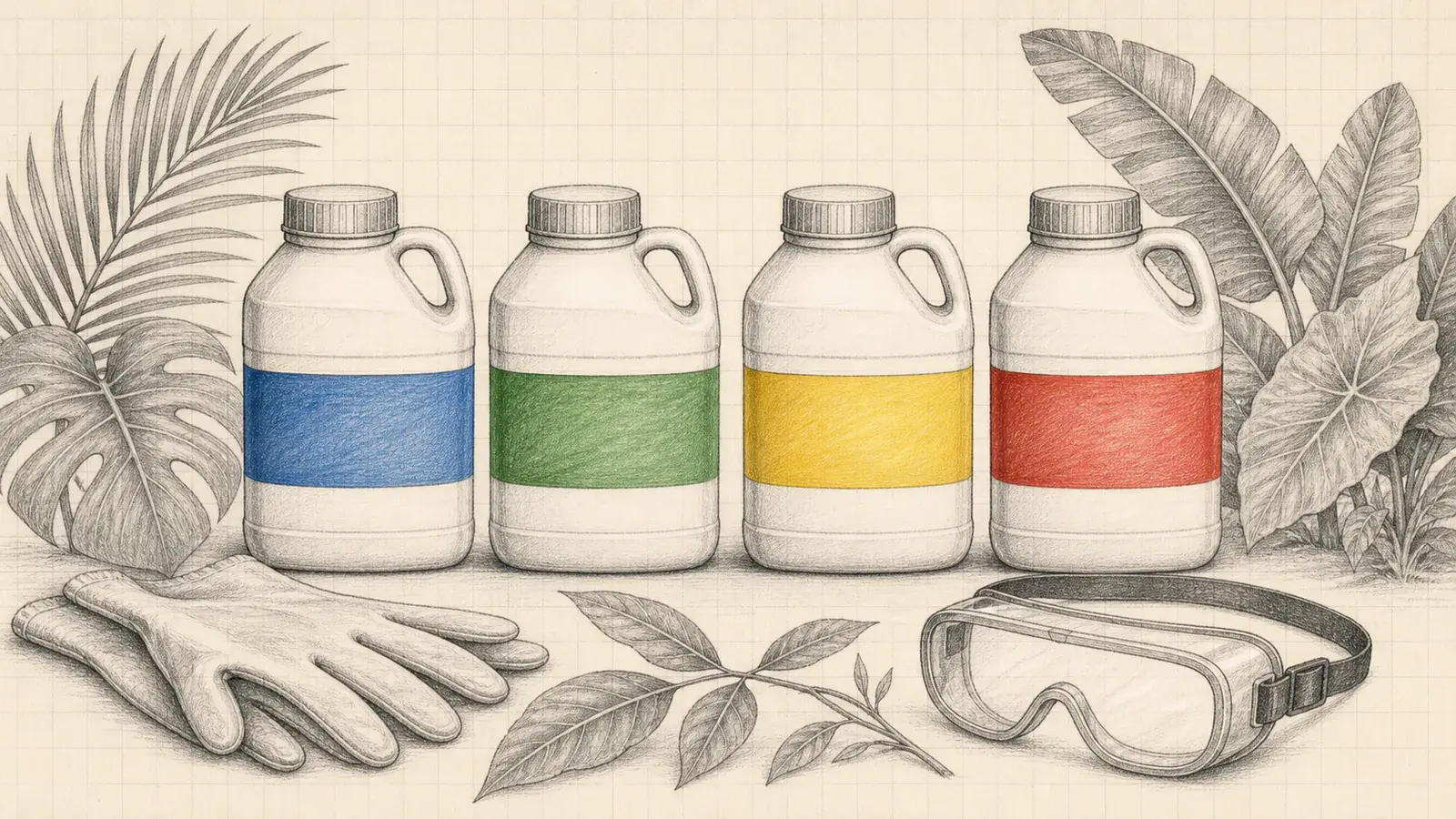
Chemical pesticides are sometimes needed in landscaping to control serious pest problems such as mealybugs, aphids, whiteflies, caterpillars, fungal disease, termites, weeds and lawn pests. However, pesticide use must always be handled carefully because different products have different toxicity levels.
In Malaysia, pesticide labels are safety instructions, not decoration. The Jabatan Pertanian Malaysia pesticide labelling guide explains that labels should help users apply products safely and effectively while reducing risk to people and the environment.
What is a pesticide label colour band?
A pesticide colour band is the coloured strip printed on the product label. It helps users quickly identify the toxicity class of the pesticide.
According to Malaysia's pesticide labelling guide, each pesticide label must show a colour band based on the class approved by Lembaga Racun Makhluk Perosak (LRMP). The label should also include warning words, safety statements and warning symbols related to the pesticide class.
For landscapers, this colour band is important because it tells the team how careful they must be before mixing, spraying, storing or transporting the pesticide.
Malaysia chemical pesticide label levels
| Class | Colour band | Warning meaning | Safety level |
|---|---|---|---|
| Class Ia | Black | Beracun-Amat Bisa / Very Highly Poisonous | Highest danger |
| Class Ib | Red | Beracun-Bisa / Highly Poisonous | Very dangerous |
| Class II | Yellow | Beracun / Poisonous | High caution |
| Class III | Blue | Berbahaya / Harmful | Moderate caution |
| Class IV | No colour / White | Keep away from food and children | Lower toxicity, still needs care |
Class Ia: Black label
- Highest danger level
- Should only be handled by trained and authorised users
- Not suitable for casual garden maintenance
- Safer alternatives should be considered first for most residential and commercial landscape jobs
Class Ib: Red label
- Strong warning level for highly poisonous products
- Should only be used when the pest issue is severe and the product is clearly suitable
- Applicators must read the label, wear proper protective equipment and keep people away from treated areas
Class II: Yellow label
- Still poisonous and must be handled carefully
- Should not be treated as a normal low-risk pesticide
- Must follow the correct dosage, target pest, target plant, application method and safety interval stated on the label
Class III: Blue label
- Labelled as harmful
- Lower toxicity than Class I and II, but not risk-free
- Still needs gloves, mask, safe mixing practice, correct storage and careful application
Class IV: White or no colour
- Lowest toxicity classification in this system
- Still must be kept away from food and children
- Can still damage plants, contaminate water or affect beneficial insects if overused
Why this matters in landscaping
- Landscaping often happens near homes, offices, hotels, malls and public areas
- Children, pets, customers, workers and visitors may be nearby
- Reading the label helps decide whether the pesticide is suitable for the pest and site
- The label helps confirm what PPE is needed, how to mix and apply the product, what emergency steps apply and how to store or dispose of it
Safe pesticide practice for landscape teams
- Inspect the plant first
- Identify the pest correctly
- Check the label class and colour band
- Use the lowest suitable risk option
- Wear PPE based on the product label
- Avoid spraying during rain or strong wind
- Keep people and pets away until safe according to label instructions
- Record product name, class, date, location, target pest and applicator name
Important reminder for property owners
Before approving pesticide work, ask: "Can I see the pesticide label before treatment?"
A professional contractor should be able to explain what product is being used, what pest it targets, what the label colour means and what safety steps are required.
Malaysia's pesticide labelling guide also notes that offences can apply for unregistered pesticides or use that does not follow label requirements.
Need help?
Ask RimbaScape to inspect the pest issue, explain the label class and choose the lowest suitable risk option before treatment starts.
Need help with this?
Send RimbaScape photos, location, sunlight condition and your budget range. We will advise whether you need plant supply, maintenance or a site visit.
Check pesticide label safetyMore Guides
Overwatering Indoor Plants: The 5W1H Guide to Healthier Roots
Learn who is most at risk, what overwatering really means, when to water and how to prevent root rot, yellow leaves and fungus gnats.
Read guideOrganic vs Chemical Insecticides Around Pets
Learn how to control garden pests with a lower-risk, targeted approach for homes where cats, dogs and other pets spend time.
Read guideLawn Maintenance Guide: Mowing, Trimming & Clean-Up
Keep your lawn neat, healthy and safe with regular mowing, grass trimming, weed removal and garden clean-up.
Read guide